The Noesians
The Sovereign Lens
To represent a worldview that is fiercely rational, dynamically adaptive, and anchored in human solidarity, the symbol must reject the tropes of traditional iconography. There are no mystical eyes, no cosmic crosses, and no symmetrical illusions of perfection.
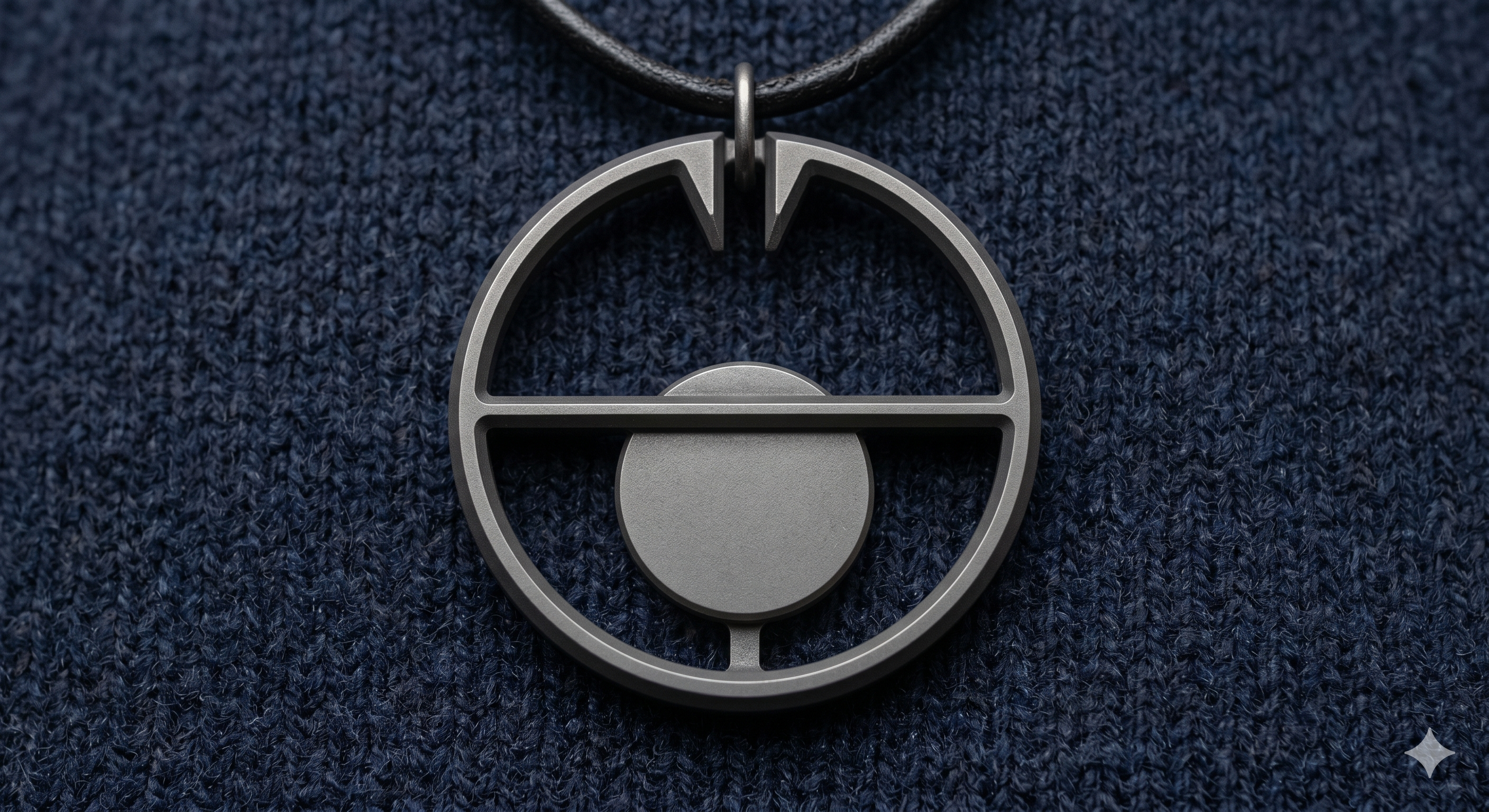
The Noesian symbol is a stark, elegant piece of geometric engineering designed to be worn as a metal lapel pin, a signet ring, or a pendant. It is called The Sovereign Lens.
The Anatomy of the Symbol
Every angle and break in the metal is a data-driven statement of our principles:
- The Fractured Outer Ring (The Open Threshold): The outermost boundary is a clean, minimalist circle representing the human campfire, the biosphere, and our shared physical ecosystem. However, it is intentionally incomplete. A precise, crisp gap is cut into the top-right of the ring (or the exact top for reversible pendants). This represents the Rite of Exit and the Eraser of Science—it is a visual reminder that our community is never a cage, our thresholds never lock, and our models are permanently open to modification when new data arrives.
- The Eccentric Core (The Lens of Reason): Suspended within the outer ring is a smaller, perfect solid circle. Crucially, it is placed off-center (eccentric). This is a deliberate subversion of the ego. It acknowledges that human beings are not the center of the cosmos, that our individual perspectives are limited, and that objective reality must be focused on through the deliberate, artificial lens of the scientific method.
- The Vector of Friction (The Line of Dissent): A single, unyielding, razor-sharp horizontal bar pierces directly through the inner lens and extends outward, passing completely through the gap in the outer ring. This represents the friction of dissent and experimentation. It is the force of critical inquiry cutting through comfortable consensus, driving human progress forward out into the unknown.
Why is it called “The Sovereign Lens”?
The name The Sovereign Lens was chosen because it perfectly captures the dual engines of Noesian philosophy: absolute intellectual independence and uncompromising empirical observation. It is a deliberate semantic weapon designed to replace traditional religious terms like “cross,” “crescent,” “star,” or “amulet”—all of which imply submission to a higher power or alignment with a cosmic script.
1. Why “Sovereign”?
- Rejection of Intellectual Hostages: Traditional belief systems demand that you surrender your sovereignty to a deity, a text, a priest, or a political party. The Sovereign Lens asserts that you are the sole author of your consciousness.
- The Power to Walk Away: You are not a subject of this community; you are a sovereign participant. You stay because the data and the connection serve your life, and you have the absolute right to walk away the moment they don’t.
- Radical Agency: To be sovereign means acknowledging that no invisible safety net is going to catch us. The responsibility for the future belongs entirely, heavily, and beautifully to us.
2. Why “Lens”?
- The Scientific Method as an Instrument: The lens represents formal logic, cognitive bias detection, and the scientific method. It is the tool we use to look past the foggy illusions of our own egos and the comforting myths of our ancestors.
- Facing the Unfiltered Cosmos: We do not look at the universe through a mirror (which just reflects our own human vanities back at us). We look through a lens, focusing our collective intellect on empirical reality, no matter how cold or vast it might be.
Real-World Manifestation: How to Wear It
The symbol is designed to look industrial, modern, and mathematically clean. It should never be crafted from fragile plastics; it should be made from materials that survive friction.
- The Lapel Pin (The Daily Signal): Cast in matte black titanium or brushed stainless steel, worn on the left lapel. It sits silently as a psychological grounding tool for the wearer and a subtle signal of intellectual hospitality to other rational minds in the room.
- The Signet Ring (The Hand of Action): A heavy, minimalist ring where the symbol is etched or debossed directly into a flat face. When a Noesian shakes a hand, signs a community mutual-aid ledger, or works with their hands, the ring faces outward—a testament to the Sovereign individual executing their labor.
- The Pendant (The Core Anchor): Suspended from a simple, rugged cord or chain, letting the Sovereign Lens rest directly over the sternum. It serves as a physical weight, a constant somatic reminder to calm the nervous system and govern the ego when reality becomes overwhelming.
The Trademark Blueprint
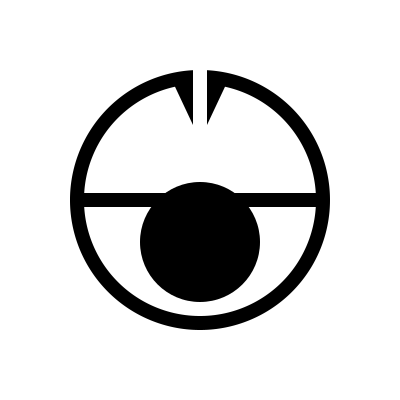
For a formal trademark application (such as with the USPTO), a logo must be submitted as a clear, high-contrast, two-dimensional drawing. By stripping away the metallic textures and depth of the physical pendant, we reduce the Sovereign Lens to its pure geometric skeleton.
Formal Mark Description (For Legal Filing): “The mark consists of a two-dimensional geometric design executed in solid, high-contrast lines. The design comprises an outer circular ring featuring a distinct, sharp break or gap at the exact top (12 o’clock position). A single, continuous solid horizontal bar passes directly through the exact geometric center of the outer ring, extending horizontally slightly past the outer perimeter on both the left and right sides. Suspended within the lower half of the outer ring is a smaller, solid concentric circle. This inner circle is perfectly centered along the vertical axis but is positioned mostly below the horizontal bar, with the bar crossing the circle at its upper 10 to 20%, creating a downward off-center orientation. The vertical axis of the entire mark reflects absolute bilateral symmetry.”